
Pumpernickel Bread
This post contains affiliate links, which means I make a small commission at no extra cost to you. You can read my full disclosure.
If you’ve ever tasted real pumpernickel bread – the dark, dense, and slightly sweet German bread, you know there’s nothing quite like it. The good news is, you don’t need molasses, black coffee, or any fancy ingredients to make it at home! Just three simple ingredients and a little patience, and you’ll have a loaf of homemade bread that is packed with a deep color, rich flavor, and rustic charm.
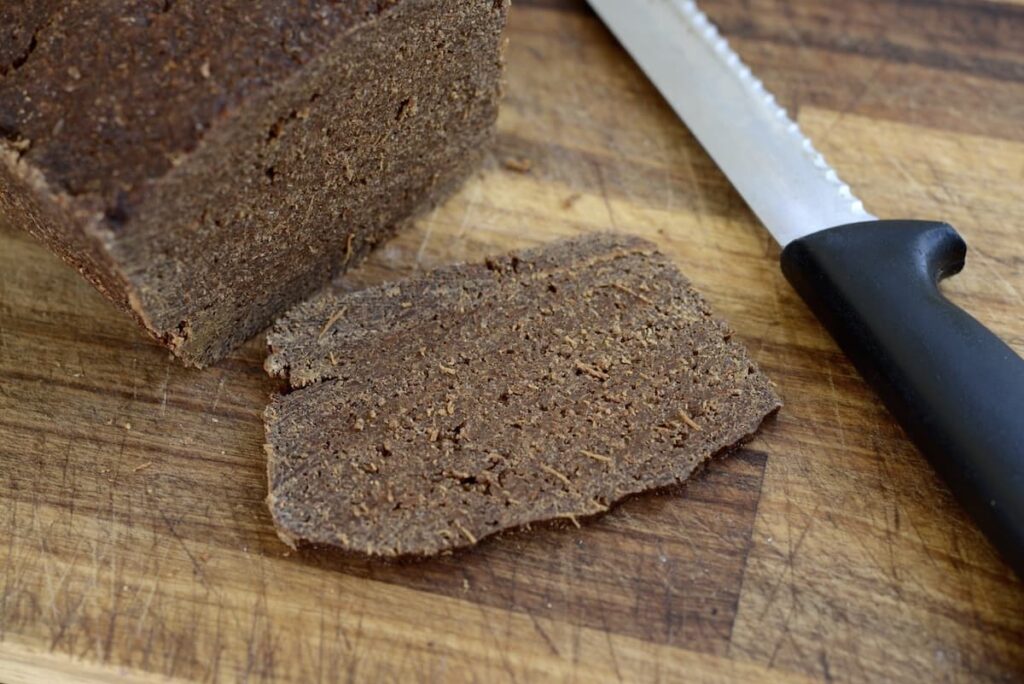
Growing up in Germany, I often had this type of bread that you can often buy in a tin where it will last forever. This simple pumpernickel recipe is very different from most recipes out there, which are more of a sandwich type of bread. I know you’ll be happy you gave this a try!
Why You’ll Love This Pumpernickel Recipe
Differences between pumpernickel bread and rye bread
Traditional pumpernickel is baked at low heat for 16–24 hours, which causes a Maillard reaction to create authentic color and flavor. Modern recipes often use molasses or coffee for color and flavor instead.
Pumpernickel bread is traditionally made with coarse whole rye grains (rye meal), and sometimes includes whole rye berries. Modern versions may use dark rye flour or a combination of flours.
Rye bread is made with rye flour, which can range in color from light to dark. It’s often blended with wheat flour to improve rise and texture.

Pumpernickel Ingredients
This is all you need to make this great bread:
- Coarse rye meal: I like to mill whole rye grains fresh with my Mockmill grain mill but you can also buy coarse rye flour (here’s an online source for rye or another source)
- Water: Not technically an ingredient but I am listing it still
- Salt: Just a little high-quality salt will elevate the flavors

Helpful tools
Some of these kitchen tools are optional, but I use all of them.
- Kitchen scale: I recommend weighing ingredients on a digital kitchen scale for accurate results, but you can find cup measurements in the recipe card.
- Grain mill: You’ll need this if you want to mill your own flour.
- Stand mixer: I love using my trusty KitchenAid stand mixer, but you can also mix the dough by hand.
- Pullman pan: The advantage of this type of loaf pan is that it comes with a lid, but a 2-pound loaf pan works just as well. I always use a 9″x5″ Pyrex loaf pan that I line with parchment paper to prevent the bread from sticking.
- Foil: To create a lid for the loaf tin
- Bread knife: I recommend slicing this bread very thinly with a very sharp bread knife
How to Make Authentic Pumpernickel Bread
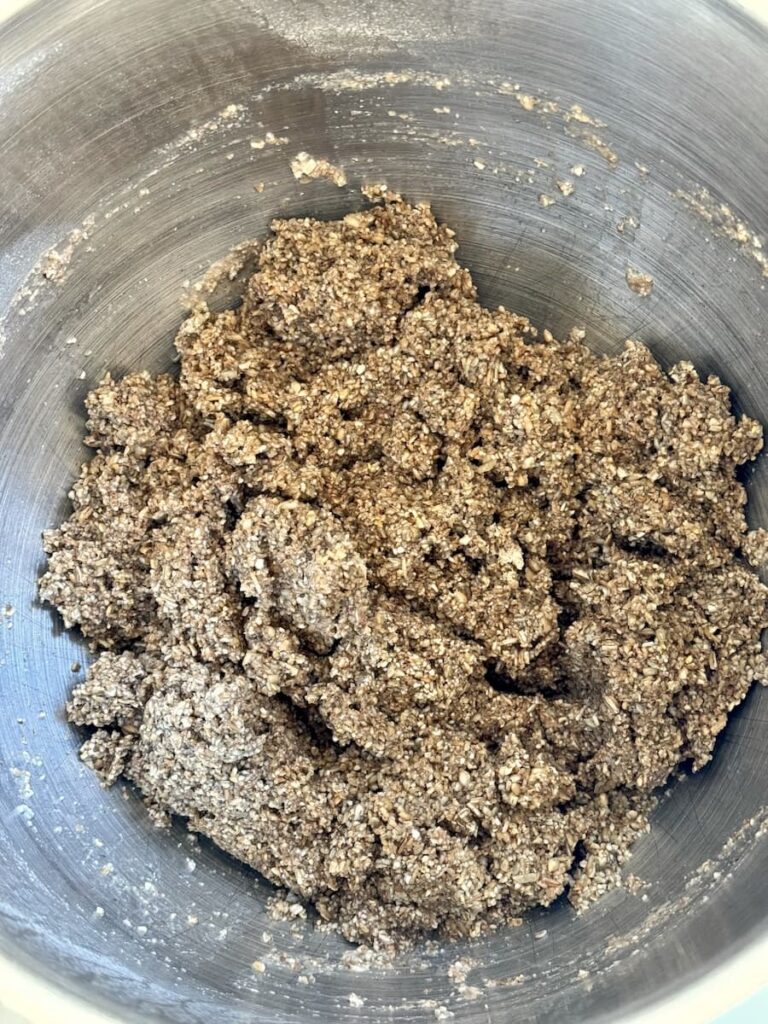
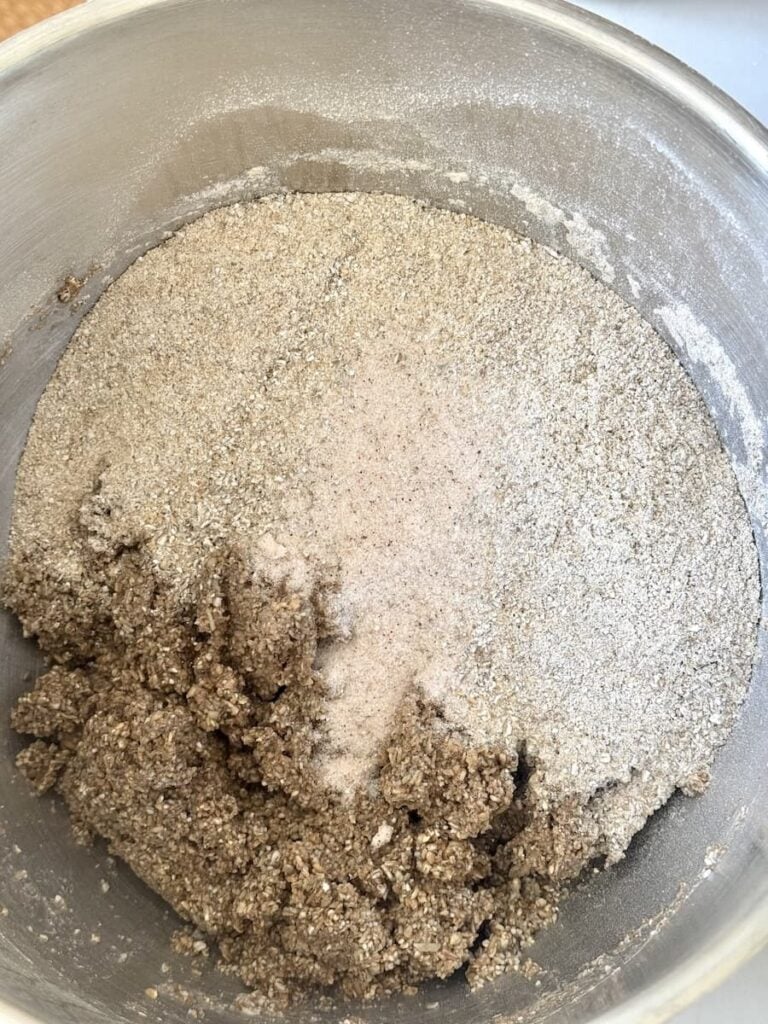
- Combine rye meal and boiling water. Cover the bowl and let the wet dough sit at room temperature for about 16 hours.
- The next day, add the remaining rye meal and the salt.
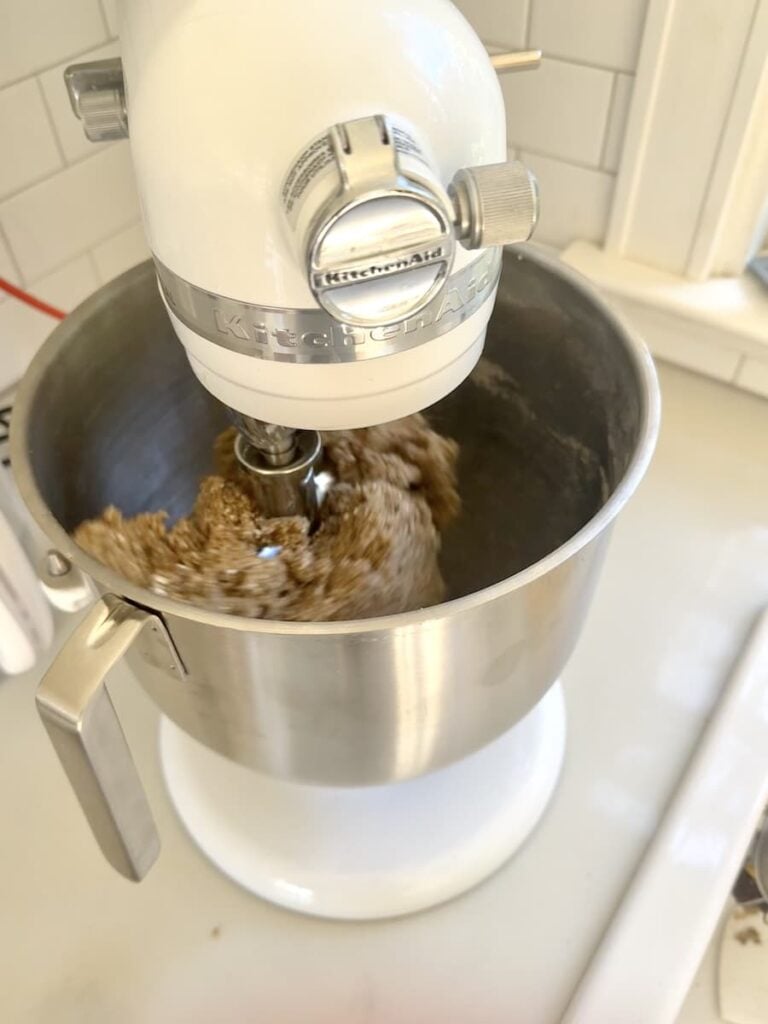
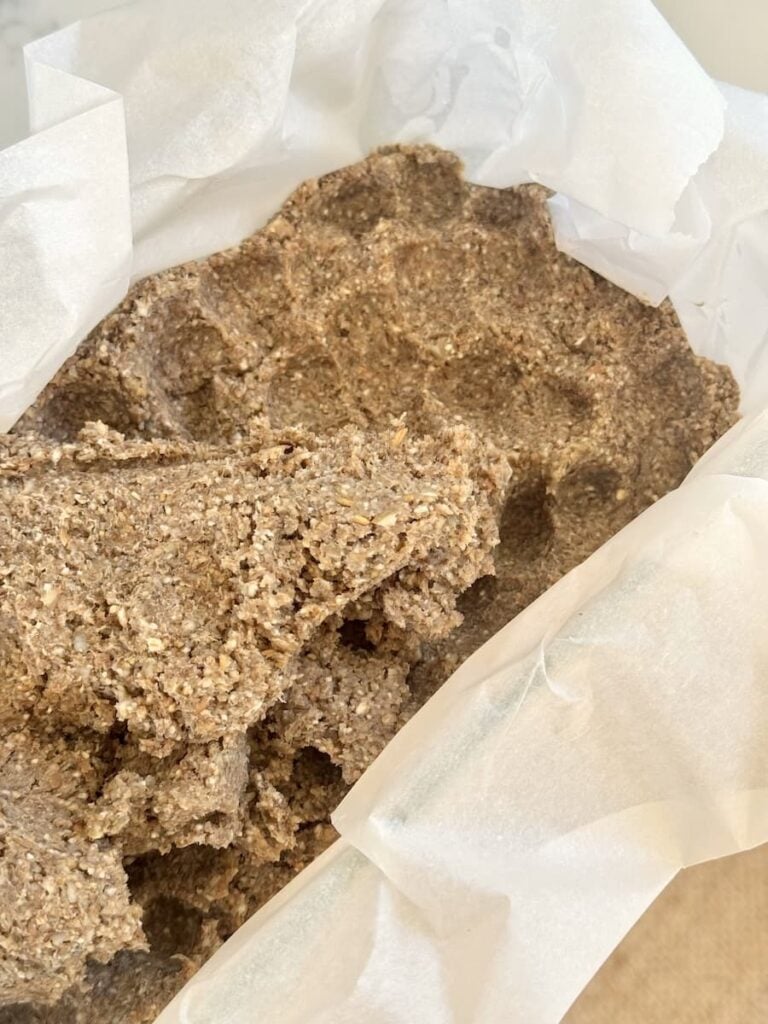
- Mix at low speed in a stand mixer for about 20 minutes. If you don’t have a stand mixer, use a wooden spoon to mix it by hand.
- Pack the pumpernickel bread dough into a lightly greased loaf pan. Be sure to smooth the top of the loaf.
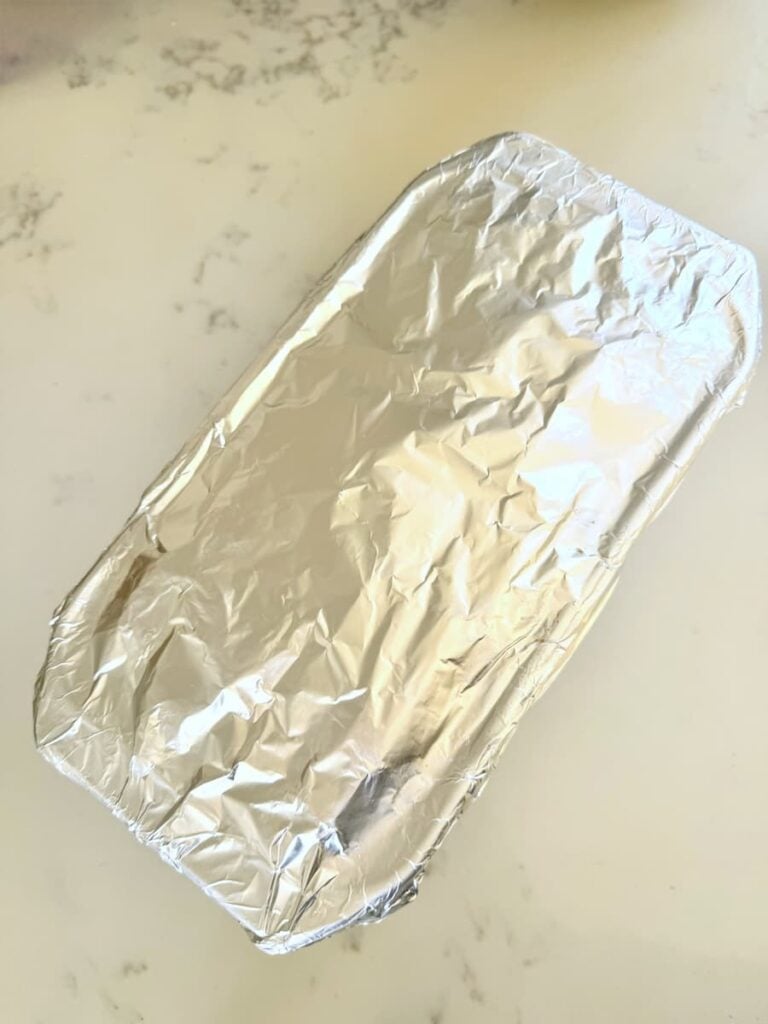
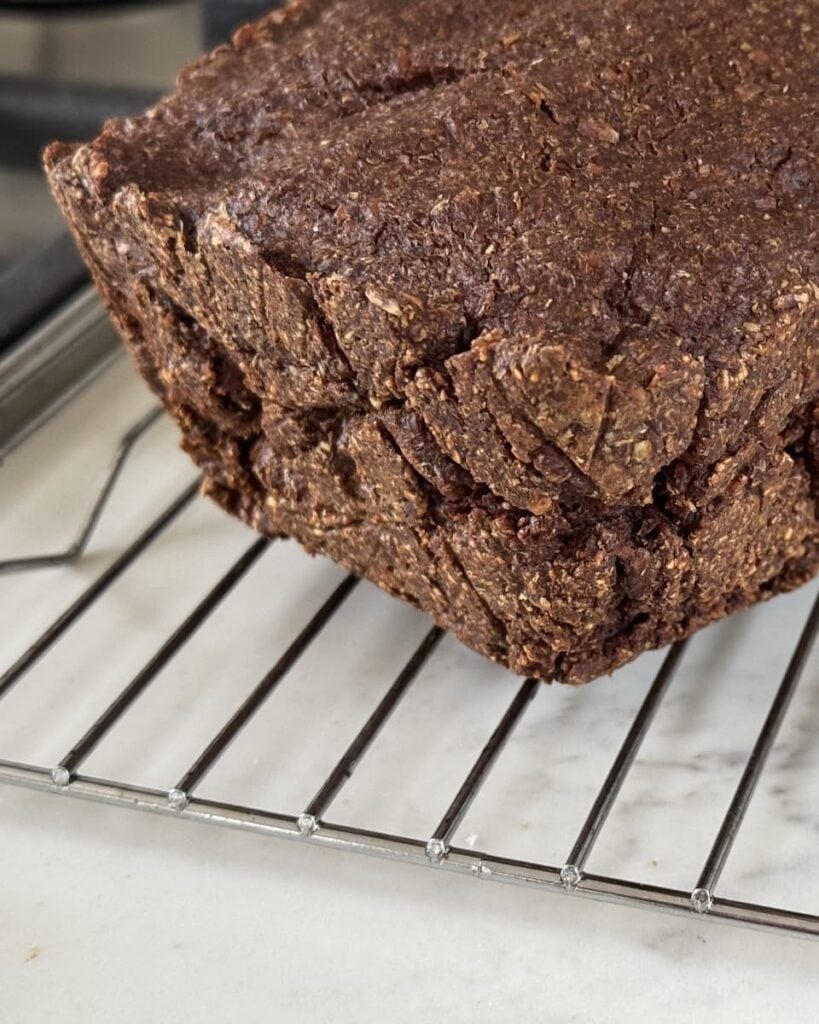
- Lightly grease the top of the loaf and cover tightly with foil. This prevents the steam from escaping.
6. Bake for 16-24 hours, then let it cool completely. Once it’s cool, wrap the pumpernickel bread in plastic wrap, and let it set for 48 hours before slicing.
Pumpernickel bread baking schedule

Notes
Anja’s notes for success
- If you’re making this bread for the first time, do not be concerned about how dense and heavy the dough will be.
- If the dough is jumping out of your stand mixer, mix it in batches. You may also initially have to scrape down the sides of the bowl to incorporate all the flour.
- The dough will initially be grey, but baking this bread at very low temperatures allows the sugars to caramelize. This creates the characteristic dark color and unique flavors of a Pumpernickel bread.
- To prevent sticking, be sure to grease the loaf pan and line it with parchment paper.
Pumpernickel recipe variations
While a traditional pumpernickel recipe has just 3 ingredients, you can play with adding these ingredients:
- Caraway seeds: You can either add whole or ground caraway seeds to your bread
- Sourdough starter: While not necessary, you can add ½ cup of sourdough starter
Serving suggestions
Here are some of my favorite ways to enjoy this traditional Pumpernickel bread but in any event, you want to slice it very thinly:
- with just some butter
- spread some butter on it and serve it with slices of cheese or cold cuts such as salami or prosciutto
- it is so delicious with some smoked salmon and a bit of horseradish sauce
- definitely try it with some smoked trout dip
- you can spread some cream cheese and chopped dill on it
- serve it with some hearty soup
Storage Tips
I recommend enjoying this bread fresh within a few days of making it. You can keep it at room temperature in a bread box, a beeswax wrap, or even plastic wrap. While I often store homemade bread in the refrigerator, I do not recommend it for this pumpernickel recipe!
For longer storage, it is much better to slice your bread, and then freeze it in an airtight freezer-safe container. Or, double-wrap the loaf in a layer of plastic wrap and foil.

Other easy bread recipes to try
Pumpernickel Bread Recipe
Ingredients
For the pre-dough:
- 700 g coarse rye meal
- 750 g boiling water
For the final dough:
- 300 g coarse rye meal
- 12 g salt
- neutral oil for greasing
Instructions
- Add rye meal to a large bowl. Add the boiling water and mix well. Cover and let stand for 16 hours.
- Add the remaining flour and salt. Mix on low speed in your stand mixer for about 20 minutes. You might have to do this in batches if your dough keeps on jumping out of the bowl. You can also mix it by hand.
- Lightly grease a 9"x5" loaf pan and line with parchment paper. Lightly grease the parchment paper. Press the dough into the prepared pan, making sure not to leave any empty spaces. Smooth the top of the dough and lightly grease it. Fold excess parchment paper over the dough and tightly cover with foil to keep steam from escaping.
- Transfer the loaf pan to a cold oven. Set temperature to 300˚F (150˚C) and bake for 45 mins. Lower the temperature to 220˚F (105˚C) and bake for an additional 16-24 hours.
- Remove the bread from the loaf pan and let it completely cool on a wire rack. Wrap it tightly in plastic and let it sit for 48 hours before cutting.
Notes
- Expect the dough to be very heavy and dense.
- Don’t be intimidated by the length of this pumpernickel recipe. It is well worth your effort, and the actual hands-on time is minimal.
Have you ever baked it in the Crock-Pot instead of the oven? I read that a Crock-Pot temperature should be just over 200*F, so I thought that might use less electricity. Excited to try!
Oh, that is a great question! I have not tried it but it might be worth experimenting. If you make it, I’d love to hear how it turned out!
I think there’s an error in the instructions – Bake for 16-14 hours
Shouldn’t that be 16-24 hours?
Apart from that, this is just the recipe I was looking for 🙂
Good catch! I will correct that right now. Thank you so much for pointing this out!
Had it for dinner today and I’m super happy. Followed the recipe exactly. I have a Bosch mixer and mixed with a dough hook for 15 min. Found that was enough. Only glitch was that my oven turned itself off. I had it in the back of my head that I read it would when we first got the oven, but couldn’t find where I saw it and google said no. Alas it did but there still was some heat when I checked at 7am so it got close to 16 hrs. Thanks for sharing the recipe!!
I am so glad that you like this pumpernickel! Happy baking!
At what point is a rye sourdough starter added, if I want to use that?
I would add it after letting the grains sit with the boiling water for 16 hours. Happy baking!
I followed your recipe exactly. The result is very tasty, but so crumbly it is impossible to cut. I settled for eating the crumbs with cottage cheese.
Where did I go wrong?
I can imagine on of these reasons: the cracked rye wasn’t hydrated enough, not enough total water, not enough total rye flour, the loaf was sliced too soon, or it was baked too long/not steamed long enough. It is a very dense, somewhat crumbly bread but you should definitely be able to slice it. Hopefully, you feel inspired to try again and adjusting one or more of those variables ~ Anja
The recipe looks good.
I don’t have a mill and have a choice of rye grain, rye flakes or stoneground dark rye flour. Can you tell me which would be best for pumpernickel please?
If you don’t have a mill I recommend getting the coarsest “flour” you can find. You might also be able to “crack” rye grains in a food processor or coffee grinder.
I would try using rye (you can probably “crack” them in a food processor) and dark rye flour.
Why do you wrap it in plastic for 2 days?
You wrap pumpernickel in plastic for 1 to 2 days so the moisture can redistribute, the cracked rye can soften fully, and the crumb can set properly. This makes the loaf easier to slice and keeps it from turning dry or crumbly.
did you mean 750 g of water or 750ml of water?
Yes, 750 mL and 750 g of water are identical because water is 1 g per 1 mL. You can use either a liquid measuring cup or place your bowl on a digital kitchen scale and weigh out 750 grams directly!
Hi Anja
I haven’t made this yet but like the look of this recipe as it appears to be more authentic than a lot of others. Most sites say that pumpernickel lasts for several weeks without freezing it but you are saying that this bread should be consumed within a few days of making it. That surprises me. Traditionally it would appear that one of the reasons people made it was because of its longevity. When I have bought pumpernickel in the past (with no preservatives added), it indeed lasted for as long as it took to consume the whole loaf and tasted just as good to the last slice. Can you tell me why this recipe has such a short life please?
Store-bought pumpernickel usually lasts longer because it’s often baked, cooled, sliced, and packaged in a very controlled environment, with less exposure to mold spores. Many brands also use preservatives, acidity regulators, pasteurization, vacuum-sealing, or modified-atmosphere packaging to slow mold growth.
Homemade pumpernickel has fewer barriers: it is handled more, wrapped in a regular kitchen environment, and usually has no preservatives. Its high moisture content also helps it stay soft, but that same moisture can make it mold faster.
The original pumpernickel — baked at low temps for 24 hours and made with coarse rye, salt and water, i.e. no preservatives, etc. — lasted for a year or more! They wrapped their loaves in linen.
Thank you so much for sharing that~
Followed the instructions, the loaf came out looking great, tastes wonderful but is very crumbly, so much so, it is impossible to slice thinly. Any advice?
I can imagine on of these reasons: the cracked rye wasn’t hydrated enough, not enough total water, not enough total rye flour, the loaf was sliced too soon, or it was baked too long/not steamed long enough. It is a very dense, somewhat crumbly bread but you should definitely be able to slice it. Hopefully, you feel inspired to try again and adjusting one or more of those variables.
Hi, the recipe looks promising and the schedule is a great help thank you! I have a question though – My understanding is that this bread was legendary for its long term keeping qualities, why is the recommendation that it’s best eat within a few days or frozen?
Thanks
Lesley
Store-bought pumpernickel usually lasts longer because it’s often baked, cooled, sliced, and packaged in a very controlled environment, with less exposure to mold spores. Many brands also use preservatives, acidity regulators, pasteurization, vacuum-sealing, or modified-atmosphere packaging to slow mold growth.
Homemade pumpernickel has fewer barriers: it is handled more, wrapped in a regular kitchen environment, and usually has no preservatives. Its high moisture content also helps it stay soft, but that same moisture can make it mold faster.
Have you seen this video: https://www.youtube.com/watch?v=R561wArN_84
It appears they are using some of your photos in it. Not sure if you gave them permission or if you care but thought I should mention it since it appears the video was generated with AI (weird collection of photos, facts and erratic narration with odd timing).
As soon as I can buy some rye berries I’m going to try this recipe and will comment on how it goes. Thanks.
Thank you so much for alerting me! I have been in touch with the creator. Hope you’ll get to make this amazing bread soon!
Have attempted this recipe twice, both times got burned to a crisp! Trying again today, wrapped in foil, at lower temps, and will check after a shorter amount of time. Wish me luck!
Oh, no! The recipe actually recommend covering the loaf pan tightly with foil. Since all ovens are a bit different, lowering the oven temperature is a good idea ~ Anja
Hello and thank you for this recipe. My first two attempts resulted in a charcoal brick so I’m giving it a third try – perhaps lower temp & length of bake? I followed your specs and baked for 24 hrs first time and about 19 the second. Not giving up!
From you other comment it looks like you figured it out. It is essential that you tightly cover it with foil. Also, verify your oven temperature.
Would you mind sharing which number you use for grinding on your Mockmill to get the correct “coarse” rye grind for this bread? Thank you in advance!
I used around like 13 or 14 but this is not an exact science ~ Anja
Great recipe! So delicious. On my first attempt, the loaf was extremely crumbly. So crumbly I could not really slice it. Any idea where I went wrong? I’m also wondering if I can just crumb the loaf up and use it again in another loaf with modification.
Thanks!
Dave
I wonder if you needed to let it sit longer before slicing (I actually recommend 24 hours) ~ Anja
The bread and the process appear SO similar to the pumpernickel my mother used to make. Along with her father and 3 brothers, she emigrated from Germany (Lower Saxony) to Canada between the 2 world wars. I think she was 13 years old when she arrived in Saskatchewan. I’m going to try your recipe but I have a question: you call for 750 g of boiling water. Do you mean 750 ml? Thank you. I’ll let you know how it turns out.
Nice! Yes, 750g is essentially 750 ml. Happy baking ~ Anja
Great recipe, it looks so simple.
Have you ever tried this with store bought regular rye?
My Hungarian grandfather used to talk about black bread in Hungary, do you think this is what he would have been talking about? He said it was heavy.
Love all your recipes!
Cindy
Most store-bought rye flour is too fine unless you can find cracked rye. The latter will give the pumpernickel its distinct texture. But yes, except for the long baking time, it is a very easy recipe ~ Anja
I’m so sorry. I hope you don’t think I am stalking you. I tried to leave a reply 3 times yesterday, but I don’t think they went through. I am concerned about this 3-ingredient pumpernickel, specifically the US customary-metric conversions. For the water, 3-1/8 cups = 750 ml(g), which is correct. But 700g of coarse rye flour would be at least 5c and 300g at least 2c. I did not realize this until I had prepared the dough with the full amount of water and a total of 4-1/4c of rye. Still waiting to see how it turns out, but I would appreciate some clarification for next time. Thank you so much–I am really looking forward to enjoying this recipe!
I am offering the imperial measurements as a courtesy and they are automatically converted. For most recipes, I highly recommend you use a digital kitchen scale to get the best and most consistent results. Hope this helps ~ Anja
How to tell when it’s fully baked?
Also does anything change when trying a half loaf?
It is really more steamed than baked but after 16 hours, it will be done and yes, you can make a smaller loaf ~ Anja
Fantastic bread. Now don’t have to buy it off the internet anymore.
Yeah! I am so happy to hear that! Enjoy ~ Anja